![[Translate to EN:]](/fileadmin/_processed_/e/f/csm_meditatives-yoga-gegen-stress_ef95559d79.png "[Translate to EN:]")
Exercise or Yoga to Combat Stress? What Really Helps
Why Hard Training Can Help You Relax in the Short Term
But meditative yoga really does change you
After your workout, you feel calm, clear-headed, and relaxed. But an hour later, you find yourself getting upset again in traffic? That’s no coincidence: Exercise reduces stress hormones, but it doesn’t train your ability to stay calm.
That’s exactly what makes meditative yoga different—it’s not a “workout,” but a “work-in.”
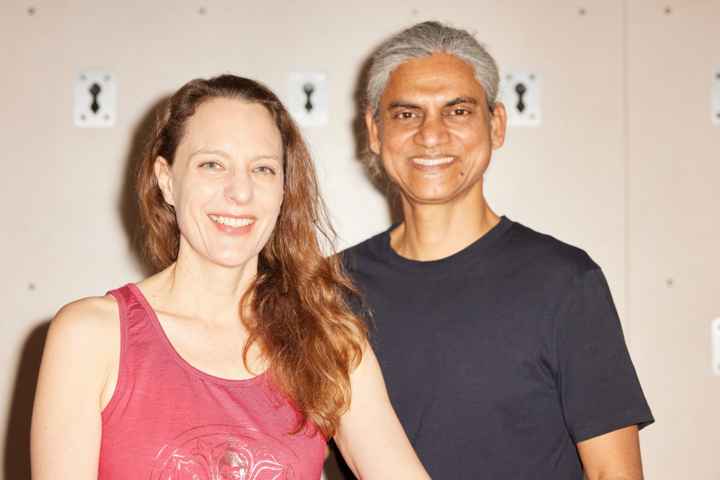
We—Tanja and Joey from The Yoga Place in Zurich—will explain why we don’t just know this in theory, but have experienced it firsthand when our bodies gave out and only meditation kept us going. And why not all yoga is meditative, even if it looks that way.
After an intense workout, most people feel calmer, clearer, and more at ease. This is no coincidence, nor is it just in their heads: something is actually happening in the body. But this is precisely where the misunderstanding lies—one that many people fall for when searching for genuine stress relief.
What Really Happens During Exercise
What Sets Meditative Yoga Apart from Exercise
A Direct Comparison: When Is Exercise Helpful, and When Is Yoga?
During intense exercise, the body releases endorphins—pain-relieving, mood-boosting neurotransmitters. At the same time, cortisol and adrenaline levels drop—the very hormones that rise during stress and tension.
The nervous system shifts from sympathetic mode (fight or flight) to parasympathetic mode (rest and recovery). Tense muscles are worked to exhaustion and then relax all the more deeply.
The result: You feel tired, but calmer inside. A real, measurable effect.
The problem: Exercise regulates the state, not the ability
This is the crucial point. Exercise changes how you feel, but it doesn’t train you how to cope with tension and stress.
The mechanism is essentially passive: The body reacts to the stress, but the brain isn’t actively trained to calm itself down without an external stimulus.
This becomes a problem precisely when you actually need to manage stress the most:
✨ in the middle of a meeting
✨ during an argument
✨ in a traffic jam
✨ when trying to fall asleep
✨ or simply when, for whatever reason (injury, age, lack of time, health limitations), you can no longer exercise.
Anyone who has left their only tool for combating stress at the gym, on their bike, or in their running shoes is left empty-handed in these moments.
What Sets Meditative Yoga Apart from Sports
Meditation—and yoga practiced meditatively—takes a different approach. Instead of relieving stress indirectly through physical exhaustion, it directly trains the ability to self-regulate.
You learn to consciously direct your attention, to notice bodily sensations and thoughts without immediately reacting emotionally, and to actively bring yourself into a calmer state using only your own mind.
From a neuroscientific perspective, this manifests in two key effects:
1. Regular meditation measurably reduces the reactivity of the amygdala, the brain region responsible for the stress response.
2. At the same time, it strengthens the connection to the prefrontal cortex, the region responsible for conscious control and emotional regulation.
In other words: You don’t train the body to calm the mind; you train the mind directly.
This is a skill. And skills, unlike a short-term surge of hormones, are portable. They work anywhere, regardless of physical condition, fitness equipment, time, or place.
Alignment Yoga: Meditative Doesn’t Mean “Just Sitting There”
At The Yoga Place Zurich, we practice Alignment Yoga in a deliberately meditative way, and this is often misunderstood. For us, meditative doesn’t mean sitting down and doing nothing.
On the contrary: We train mindfulness and concentration directly through movement.
Every alignment, every transition from one position to the next, every conscious adjustment of posture requires full presence.
You can’t think about your shopping list on the side while simultaneously keeping an eye on the alignment of your pelvis, spine, and breath.
It is precisely this form of concentrated, physically grounded attention that is meditation in motion—a highly focused, mindful flow—not in quickly performed yoga poses, but in holding the asana.
We consciously avoid external stimuli such as music. Not out of strictness, but because every additional stimulus distracts from the very ability we actually want to cultivate: maintaining our own attention without external distractions.
Those who learn to focus on their own breath and movement in silence develop a capacity for mindfulness and concentration that extends far beyond the yoga mat.
Our Own Story: Tanja and Joey
We’re not extreme athletes, and sports were never our only outlet. Fortunately, because that’s exactly what was put to the test at one point.
For Joey, it started with his neck. There was a period when practically nothing was possible—no sports, none of his yoga exercises. Going for walks and meditating—that was still possible, but nothing more.
Shortly after that, a second, more serious issue arose: a congenital heart defect that flared up right at that time because Joey could no longer perform his most important yoga exercises.
These weren’t workout exercises, but very specific, therapeutic yoga exercises for the heart that kept his heart stable. With his injured neck, however, he could no longer perform them without further aggravating the injury.
It was a truly difficult time. Health problems almost always trigger fears, and this is especially true when it comes to the heart.
What sustained Joey during this time was meditation. The one tool he had left was precisely the one that wasn’t tied to the body. With it, he was able to manage his fears and emotions, even when his body itself no longer offered any sense of security.
For me, Tanja, it was my back. I’d overdone it with yoga in the past—a classic mistake—and was paying the price for it in my early 40s.
It also helped me that I was already meditating at the time, and above all, that I had long since been practicing my yoga exercises with a meditative focus rather than purely physically.
That made a noticeable difference. Of course, you still feel better when your body isn’t in pain—pain clouds the mind, and we won’t sugarcoat that.
But the practice was already there before I really needed it.
That’s exactly the point we want to convey most: It’s much easier to fall back on an existing meditation practice during a crisis than to start from scratch when your body is failing you.
Those who already have something “in the bank” get through such phases differently than someone who’s completely thrown off track, without any reserves of mindfulness or meditation.
So for anyone who’s currently feeling thrown off track, we’d offer to start yoga with us—not as a substitute workout, but to experience that it’s not about the “work-out,” but about the “work-in”.
But we’d most like to reach out to those who haven’t hit a wall yet—but who haven’t invested much in mindfulness or meditation so far. Because the best time to build up a reserve isn’t when you’re already in desperate need of it.
Not all yoga is meditative
At this point, it’s worth making an important clarification: Not all yoga is automatically meditative.
In many places, especially at gyms, yoga is simply offered as just another form of exercise. The physical aspect takes center stage there: as dynamic as possible, as challenging as possible, as sweat-inducing as possible.
The desired effect is then the same as with a classic workout. You leave the class exhausted, feel great for a moment—“what a great class, I’m totally wiped out”—and that’s actually true; the exercise hormones are kicking in.
But just like with strength training or jogging, the actual skill wasn’t worked on: the ability to regulate oneself. You wore yourself out; you didn’t train yourself to stay calm.
The result is familiar: You leave the yoga class wonderfully exhausted, and twenty minutes later you’re stuck in traffic or crammed into a tram, and you get just as worked up as always.
The body was relaxed, but the mind was never trained.
That is precisely the difference we mean when we speak of meditative yoga.
It’s not about whether a yoga class is strenuous or not—meditative yoga can certainly be strenuous.
It’s about how you relate to yourself within the movement: consciously, with focus, and mindfully attuned to your breath and your inner response, rather than just on the next goal or the next asana.
You don’t feel this difference during the class itself, but afterward—in everyday life, in traffic, during an argument—in the moment when it really counts.
The Honest Assessment
This is not meant to be an argument against exercise. Exercise has its own irreplaceable benefits: for the cardiovascular system, muscles, and sleep quality.
And the strongest effects on stress resilience often emerge precisely from the combination of both.
But the core message remains: Those who rely solely on exercise as a tool against stress have a stopgap solution—effective, but situation-dependent and tied to the body.
Those who practice meditation or meditative yoga—such as our Alignment Yoga at The Yoga Place Zurich—have a robust skill that is independent of the body, one that continues to support them even when exercise is no longer an option.
This is exactly what we observe among many of our participants: very few come to us because they’ve stopped being physically active.
On the contrary, many run, swim, do strength training, or ride a bike—and still come to our studio regularly to practice on the mat.
Not as a replacement, but as a complement, because they’ve realized for themselves that one doesn’t replace the other.
If you want to unwind in the short term, you go for a run. If you want to learn how to manage stress in the long term, you come to our studio.
And you?
Do you do both—sports and meditative yoga—or have you focused mainly on one so far? Have you ever gone through a phase where your body held you back, and what helped you wind down then?
If you’re curious about how meditative yoga can make a difference for you, just stop by and try it out for yourself. We look forward to seeing you! 🙏🏼